
New Delhi: As the rapid recurring floods,
disaster and ethnic conflicts hit Assam, the people there are witnessing
a massive change in their livelihood pattern.
The deteriorating livelihood in Assam has made it a hot-spot for human traffickers.
Around
422 victims of human trafficking, mostly minors, were rescued by the
Assam Police and arrested 281 offenders since 2011, according to the
Criminal Investigation Department (CID).
Official records show that of the total 93 victims of trafficking in 2011, 36 were minors and of these 36, 28 were girls.
The number of victims went up to 188 in 2013 and 94 were found to be below 18 years.
Infact,
recently 59 minor girls from Assam were rescued from a factory in
Mumbai, who were made to work for long hours without any food and rest
and were paid a meager amount for their services.
However, apart from these rescued children, there are thousands of children who have been trafficked from Assam to other cities.
According
to the media reports, over 4000 children have gone missing in the last
five years, out of which around 2,718 are females.
The traffickers
take advantage of violent incidents and riots when both police and the
administration are busy in controlling the situationand trap the
families by alluring them with money and take the children with them.
The
traffickers usually sell these children to the placement agencies where
girls are sold for prostitution, minor boys are taken out for cheap
labour.
Most of the girls from Assam who fall prey of these traffickers end up in brothels in the various cities.
According to another media report, around 10 women are abducted on a daily basis in Assam, and most of them are left untraced.

While the Opposition AIUDF demanded resignation of the government as
"it has no moral right", Chief Minister Tarun Gogoi said the 16-year-old
girl Priya Basumatary was "not a police informer".
As soon as the House met this morning, BPF MLA Pramila Rani Brahma
raised the issue of killing of the girl at the beginning of the Question
Hour, when Gogoi was present.
Joining her and adding the issue of violence at Uriamghat area in
Golaghat district along the Assam-Nagaland border and the subsequent
deterioration of law and order situation in the district, entire
Opposition rose on their feet and shouted demanding a discussion over
the two issues.
AIUDF's Abdur Rahim Khan said, "Meghalaya, Nagaland, Arunachal
Pradesh -- everyone is killing Assamese people. This government has no
moral right to stay and it should resign immediately."
Brahma then walked into the well of the House and stood just in front
of the Speaker's table for around 10 minutes raising the law and order
situation of the state. Speaker Pranab Kumar Gogoi said "Priya was
killed a couple of days back but everyone kept silent. But after few
days only, all started reacting and now you are also raising the
issue... I will request the CM to make a statement after the Question
Hour."
On this, AGP MLA Padma Hazarika said only a statement from the Chief
Minister would not work and a discussion was needed as these two were
very serious law and order issues.
Another AGP MLA Phani Bhusan Choudhury said the House can discuss the
issue as per Section 144(2) of the rules of the Assembly proceedings
provided the Speaker agrees to it. Congress MLA Himanta Biswa Sarma also
urged the Speaker to give time to discuss the issues.
Guwahati, Aug 20: Assam suffers
an average loss of Rs 200 crore every year due to devastating floods
with nearly 40 per cent of the state’s total land declared as
flood-prone by the government. According to the Economic Survey,
Assam for 2013-14 tabled in the Assembly during the ongoing Budget
session, the average annual loss due to flood in Assam is to the tune of
Rs 200 crore and in 1998, the loss suffered was about Rs 500 crore.
During 2004 it was about Rs 771 crore, the document said. The survey
also pointed out that the national average of flood-prone area in the
state was about a quarter of the total land area of the state. ”The
flood-prone area of the state is 31,500 sq km as assessed by the
Rastriya Barh Ayog which is about 39.58 per cent of the total land area
of Assam. This is about 9.4 per cent of total flood-prone area of the
whole country,” it said.
The survey said the flood-prone area of India as a whole stands at
about 10.2 per cent of the total area of the country. ”Records show that
average annual area affected by flood (in Assam) is 9.31 lakh hectares.
The flood protected area of the state is 16,500 sq km (16.5 lakh
hectares) till date,” the survey pointed out.
Besides, the scale of the problem has grown with massive erosion,
which stands at an average rate of 8,000 hectares every year in the
state with a total of 4.27 lakh hectares of land having been washed away
since 1950. During post Independence period, Assam faced major floods
in 1954, 1962, 1972, 1977, 1984, 1988, 1998, 2002 and 2004, the survey
said.

GUWAHATI: People in the state perhaps still remember the ghastly incident in which 38 people of Shikarigaon, a remote village in Majuli Island, were branded as witches and ostracized by their fellow villagers last year. This was not the last case of witch-hunting in the state.
Last month, an elderly couple from Sapekhaiti village of Udalguri district, were chased out by villagers on a similar charge. Since then, the couple are spending their days in hiding. What is even more strange is that the husband is a former college principal.
Even as the state boasts of making progress on the economic and other fronts, there also many cases of witch-hunting and other superstitious practices that victimize scores of people and even take lives.
According to social activist and general secretary of Brothers, an NGO working against witch-hunting, Dibyajyoti Saikia, at least 20 cases of witch-hunting were reported and five persons killed so far this year.
Saikia said on Saturday that between 2008 to October 2013, 81 people were killed for being 'witches'.
"The superstition of witch-hunting has become a bane for the state. Cases are increasing. Yet we don't have a strong legislation to deal with the superstition," Saikia said.
With the budget session still going on, social organizations have upped the ante for placing a strong bill in the assembly to stop witch-hunting in the state.
"The chief minister had last year promised that a strong anti-superstition legislation would be put in place to fight witch-hunting in the state. But, we are yet to see such legislation. People are being harassed and killed in the name of witch-hunting. Our demand is that the government actively consider placing a bill in the assembly," Saikia said.
Saikia has threatened to agitate from August 25, demanding a strong legislation to fight witch-hunting and other superstitious practices in the state.
He observed that with the passage of time the practice of witch-hunting is becoming more complex with personal enmity and vested interest coming into play.
"There was a time when the majority of the victims were women. For the last seven to eight years, we have observed that 40 per cent of the victims were male. This calls for urgent attention from the government," Saikia added.
Guwahati:
From being one of the most prosperous states of the country
post-Independence, to one of its poorest, Assam has been on a
roller-coaster ride for 68 years.
However, as the country
celebrates its 68th Independence Day, the state, with a prudent
financial plan in place, has set itself a growth rate of 6.88%, above
the national projection.
In 1950-51, Assam had an enviable per
capita income of 4% above the national average. With floods,
infiltration and militancy wreaking havoc, its per capita income dropped
to 41% below the national average in 1998-99.
Said the
Planning Commission, "What is more alarming is that the gap (between the
state and national per capita income) is growing. Between 1980 and
1990, per capita income (at 1980-81 prices) grew by 20% in Assam,
compared to 40% for India. Between 1980 and 1998, per capita income in
Assam grew by 10%, compared to 39% for India."
For almost three
decades, between 1951 and 1979, all was well with the state's finances
as its economy grew at more or less the same rate as the rest of the
country.
A report of the Planning Commission states, "Assam's
per capita income fell due to a higher rate of population growth caused
by immigration. Over the period, Assam's population grew at an average
rate of around 4% per year. The widening disparity since 1980-81 is,
however, due to slower growth of its economy. While the Indian economy
grew at 6% between 1981 and 2000, Assam's GDP grew at 3.3%. While the
growth rate of the Indian economy accelerated in the 1990s, Assam's
economy decelerated."
There was a fall in the growth rate of
electricity, gas and water supply and in the construction sector.
Capital expenditure for development also fell and these resulted in
fewer job opportunities and rising unemployment.
"Assam is the
only major state in India that showed increasing rural poverty between
1957 and 1994," the commission report said.
It has identified
small agriculture operational landholding size and agriculture
development, floods and erosion, infiltration from Bangladesh and
militancy as the causes for the downturn.
"Unless extortion by
various insurgent groups is brought under control, industrial growth is
unlikely to accelerate. Assam is a complex state with huge ethnic
diversity, Bangladeshi immigrants and an educated middle-class
frustrated by poor economic development," the commission suggested.
Then there was the six-year-long anti-foreigners movement which stalled
all development activities in the state. The post-Assam Accord period
wasn't much better. The Planning Commission, quoting data over a 15-year
period, from 1984-85 to 1999, said the state recognizes the "failure of
revenue receipts to meet...the rapidly growing expenditure commitments,
particularly expenditure on salaries, wages, allowances and pensions".
There were heavy losses from negligible returns on capital expenditure
on projects and investments in public-sector undertakings, declining
buoyancy of state tax revenues and the consequent rising costs of public
debt and higher borrowings.
The Economic Survey of Assam,
2013-14, states, "The fiscal reform measures adopted by the state
started yielding favourable results since 2005-06 and moved with revenue
and fiscal surplus during the period from 2005-06 to 2008-09 and
subsequent years of 2010-11, 2011-12 and 2012-13.
Chief
minister Tarun Gogoi is ready to scale new heights. While his rivals
criticize him for the growing debt burden, which stands at Rs 27,248.16
crore, Gogoi sees this more as a device which will protect the
government of cost escalation a decade later.
"Gujarat's debt
burden is Rs 1.5 lakh crore and ours is just Rs 27,248 crore. I ask my
officers to go for more loans because a loan taken today will protect me
from rising costs 10 years later," Gogoi said.
GUWAHATI, Aug 14 – Over 9,000 cases of HIV have been detected so far in Assam, the State government said today.
In a written reply in the Assembly on behalf of the Health Minister, State Agriculture Minister Nilamani Sen Deka said that as on March 31, 2014, a total of 9,110 cases of HIV (+ve) people had been detected in the State.
The highest number of such cases was in Kamrup Metro district (3,570), followed by Cachar (1,866), Dibrugarh (630), Nagaon (418) and Golaghat (304).
Deka said steps have been taken for prevention of HIV/AIDS, with the Assam State AIDS Control Society implementing the National AIDS Control Programme (NACP) as per the Department of AIDS Control’s strategic plan.
Targeted intervention among high risk groups like female sex workers, injecting drug users (IDU), truckers, migrants and others is being implemented through selected NGOs.

The unclaimed dead body was identified as one late Munde (20 years) from
Assam was found hanging on July 12. She reportedly came to Delhi in
search of domestic job after her parents expired
According to report received from Delhi, the in charge of the Assam
Bhavan at New Delhi was informed on the incident at the time when Munde
was found suicide. However, none of the representatives of Assam Bhavan
responded nor her relatives came to claim the body.
The sources said that the body which was lying for 11 days was buried
after cousin brother of a girl was informed and brought from Assam.
Sanjay Brahma, Delhi Police representing North East from Assam Police
and North East, volunteers from Bangalore, North East officials from
Delhi and priest conducted the last rite at forlorn graveyard.
It is also reported that the brother of the girl who lives in Bangalore
was informed of the incident, however due to poverty he could not come
to Delhi for the last rite.
The North East People of New Delhi have expressed gratitude to Alemtemsu
Jamir, former Chief Secretary of Nagaland, for providing coffin and
other materials for the burial. It has also thanked Sanjay Brahma, Delhi
Police, for taking all the troubles till the last rite, and the North
East volunteers from Bangalore for their presence and initiation for the
last rite of the body and many well wishers for every contribution for
conducting the last rite.
Meanwhile, North East People of Delhi have expressed displeasure on the
part of Assam Bhavan New Delhi, who in spite of putting repeated
attention on the incident, did not response nor from Assam state
Government to claim the body which was kept for 11 days at DDU Hospital
Delhi.
Guwahati:
The Mushalpur area of Baksa district in Assam’s Bodoland Territorial
Areas District (BTAD) witnessed mass protest on Thursday following the
killing of one student leader Manoj Das on Wednesday evening.
The protestors are demanding the arrest of the culprits who gunned
down Das who was associated with a non-Bodo organization -- Oboro
Suraksha Samittee. The protestors are also refusing to perform the last
rites of the deceased student leader till the culprits are booked.
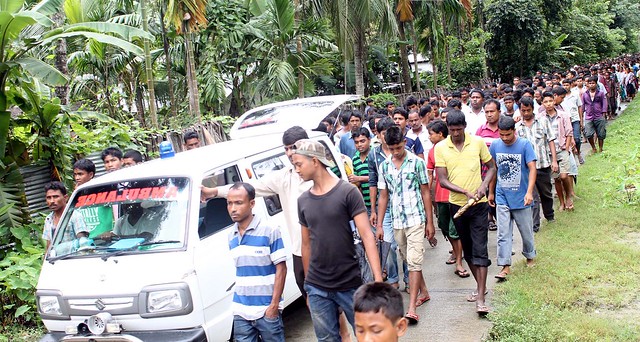
The villagers carry the body of slain student leader Manoj Das at Mushalpur area on Thursday.
According to police reports at around 7.05 pm on Wednesday evening some unidentified miscreants fired at Manoj Das (35), son of Prabhat Das of Belguri Pathar (Sirish Bari) under Mashalpur Police Station when he was about to leave for his residence along with his sick father who came to a pharmacy.
Many suspect it to be a handy work of former militants of Bodo Liberation Tigers (BLT) for supporting a non-Bodo candidate during the Lok Sabha election in the Kokrajhar constituency. Non-Bodo candidate Heera alias Naba Kumar Sarania emerged victorious in a huge margin against the candidates of Bodoland People’s Front (BPF) and Bodoland People’s Progressive Front (BPPF).
Several organizations and students’ bodies have condemned the incident and demanded arrest of the culprit.
“Manoj Das was killed by the militants of BLT for supporting Heera Sarania in the Lok Sabha polls. We demand that the culprits should be booked immediately and the government should ensure peace in the region,” said Zamsher Ali, president of BTAD Citizen Rights Forum (BCRF) who is also the chief spokesperson of Sanmilito Jonogosthiyo Oikya Mancho (SJPOM), an umbrella body of different non-Bodo organizations.
All Assam Minority Students’ Union (AAMSU), All BTC Minority Students’ Union (ABMSU) and others too staged protest throughout the day at different places of BTAD demanding the arrest of the culprits.
“This is a serious matter of concern. The people are being killed every day in the BTAD area but the government and administration are not doing enough for the safety and security of the common people. We demand that the administration should put all the efforts to nab the culprits,” said AAMSU vice president Ainuddin Ahmed.
Baska police has launched operation in the district to apprehend the culprits. Inspector General of Police S.N. Singh has also moved to Mashalpur to supervise the situation.
A few days ago four Muslim traders were also killed by Bodo militants in Baksa district. Besides another 45 people of Muslim community were also gunned down by the militants in May this year. However, no major step was taken the state government.
Kokrajhar MP Heera Sarania also condemned the incident and he vowed to raise the issue in the parliament. “We have been appealing to the government to take necessary action to stop the killings of human being but it is still going on. We condemn such act of violence and barbarism. We will raise the issue in the parliament,” Sarania said.
The availability of illegal arms is believed to be one prime reason for these rampant killings. A delegation of SJPOM will shortly visit the union home minister Rajnath Singh, Prime Minister Narendra Modi and President Pranab Mukherjee seeking solution to the problems of BTAD.
“The state government has utterly failed to control the killings in the BTAD. Time and again we have been appealing the chief minister Tarun Gogoi but in vain. During meetings he approved of doing things but in reality those things never take place. So we will meet the central ministers and president for their intervention,” SJPOM chief spokes person Zamsher Ali told TwoCircles.net.
A senior police official of the state said more than 100 illegal arms were seized in BTAD during the time of elections. He added that since January this year, 42 militants of National Democratic Front of Bodoland (Songbijit faction) have laid down their arms, while 18 others have been killed in encounters by police and the Army. According to sources, there are more than 200 members of NDFB(S) active in BTAD at present.
Along with others the Bodo Sahitya Sabha (BSS), the literary body of Bodo people, has also condemned the killing of Das. In a statement issued by the literary body appealed the public to maintain peace and harmony.
Japanese encephalitis claimed 165 lives in Guwahati. ( Express photo by Partha Paul )

Summary
The CM directed the officials to ensure adequate supply of vaccine and medicine to big hospitals. A total of 165 persons have lost their lives in Assam due to Japanese Encephalitis and Acute Encephalitis Syndrome, prompting Chief Minister Tarun Gogoi to call an emergency meeting with health officials on Wednesday.According to an official release, Gogoi held an emergency meeting to review the health scenario with senior officials in the backdrop of outbreak of Japanese Encephalitis (JE) and Acute Encephalitis Syndrome (AES).
“Reviewing the health scenario in the backdrop of growing incidence of JE and AES in the state which has claimed 165 lives so far, Chief Minister Gogoi directed the health authorities to gear up on war-footing to control the diseases from spreading to newer areas,” the release said.
While AES accounted for 60 per cent of the cases covering 24 districts this year, JE was responsible for 40 per cent of the cases in mainly lower Assam districts, it said.
Gogoi asked the officials to make a comprehensive action plan to control JE and AES, including setting up of an ICU in each district hospital for treatment of emergency cases along with and laboratory testing units, the release said.
He directed the health officials to procure laboratory testing kits for quick diagnosis of cases and also to carry out intensive fogging in the affected and nearby areas and also conduct awareness campaigns by involving the panchayats.
The Chief Minister directed the officials to ensure adequate supply of vaccine and medicine to big hospitals, district hospitals and other health centres.
“Ensure that there is no shortage of medicine. Procure the required medicine, specially life saving drugs and make them available at all health centres immediately. Speedy treatment must be ensured to save precious lives. Funds would be no constraints in tackling the situation,” he added.
Gogoi directed senior officials of the Public Health Engineering Department (PHED) to speed up the conversion work of shallow tube wells into deep tube wells, specially in affected areas to bring down the cases of AES disease.
“Proper mapping of areas where water-borne diseases are acute, must be carried out by the PHED and necessary measures be taken up to provide clean drinking water to arrest the incidence of AES cases,” he said and further directed the health officials to expedite the process for setting up the Assam State Health Corporation.
“The health officials apprised the Chief Minister that the process is on and the proposal will be placed in the Cabinet soon,” the statement said. The meeting was attended by Chief Secretary Jitesh Khosla, Principal Secretary to CM MGVK Bhanu, Principal Secretary for Health and Family Welfare Sanjeeva Kumar, NRHM Managing Director Manish Thakur and other senior officials of the PHED.
NEW DELHI: Tarun Gogoi may be ejected as chief minister of Assam this week.
The likelihood of his immediate replacement comes in the wake of the report submitted to Congress chief Sonia Gandhi by central observer Mallikarjuna Kharge who went to Guwahati to seek the views of MLAs and MPs last month. Kharge is said to have said that a majority of party MLAs are in favour of a change of guard.
Assam health minister Himanta Biswa Sarma, who has been leading the dissidence against Gogoi, is likely to be the next chief minister. Sarma was a close confidant of Gogoi before the two fell out some time back.
Gogoi's exit would mean the first scalp following Congress's Lok Sabha rout, with the sword also hanging over Maharashtra chief minister Prithviraj Chavan. Congress was nearly swept out in Assam and Maharashtra contrary to pre-poll expectations that it would post a decent performance. BJP posted its best show ever in both the states.
Sources said the party has taken the decision on Gogoi and the Assam government could see a new leader as early as this week. A senior Assam leader said the state unit was eagerly awaiting the change of guard so that it can begin the repair work on the organizational front.
This is likely to scale up expectations in the Congress over the post-rout overhaul promised by the leadership. The Antony committee is set to submit its report on the reasons of the LS debacle any time now. The informal panel was entrusted the task of documenting the views of state leaders on the reasons of defeat after Sonia Gandhi and Rahul Gandhi had held discussions with main players of all states.
The report may also decide on the fate of Maharashtra chief minister. His removal had appeared near certain before it was put on hold by the leadership following discussions with ally NCP. The state government later took critical decisions like giving job quotas to Maratha and Muslim communities, putting a question mark on the removal. Maharashtra goes to polls in October along with Haryana.
Rangiya (Assam): A State Bank of India's ATM was uprooted from its kiosk and Rs 5.38 lakh were looted from it by robbers in Kamrup (Rural) district, police said on Tuesday.
The bank's agents had deposited Rs 45 lakh in the ATM near the Rangiya railway station last evening and a group of about 12 robber came late last night and lifted the entire machine and looted Rs 5.38 lakh while the remaining amount had been already withdrawn. The ATM was yet to be traced.
Rangiya Sub-divisional Police Officer Kanteswar Gogoi along with other police officials visited the spot this morning and suspected that the agents had not fitted the machine properly.
Gogoi said they suspected that some members of the agency responsible for depositing money were conniving with some persons to loot money from ATMs by lifting the machines which were not installed properly.
There was no security personnel, who are usually appointed by the agency, at the ATM, Gogoi said.
A similar incident had occurred in Rangia about a month ago with the machine later recovered from a pond, but an amount of Rs 25 lakh which was looted was yet to be recovered. Gogoi said that they had started investigations and would soon arrest the culprits.

GUWAHATI:
Assam chief minister Tarun Gogoi has sought Prime Minister Narendra
Modi's intervention for creation of the proposed Brahmaputra River
Valley Authority (BRVA) and an IIM in Assam.
In a letter to the
Prime Minister, Gogoi sought the BRVA to be created by revamping and
restructuring the existing Brahmaputra Board within a short time frame.
Gogoi in his letter said the creation of BRVA was of paramount
importance to tackle the perpetual flood and erosion problem and
water-related hazards in Assam and the North East as a whole.
"We
are facing formidable challenges in flood and erosion management sector
due to non-implementation of integrated water resources management of
the complex Brahmaputra river system since long," Gogoi said.
A
chief minister's office (CMO) press release quoted Gogoi as also
writing, "Though Government of India had announced creation of the North
East Water Resources Authority (NEWRA) for harnessing vast water
resources of North East region in 2004, it did not materialise due to
objections raised by Arunachal Pradesh".
"Till this matter is
resolved, Government of India may constitute the BRVA to tackle the
flood and erosion problems in the region", he said.
A proposal for
creation of BRVA is under active consideration of the central government
and Assam Government has already placed its requisite views before
government of India during November 2012, the release said.
The
chief minister also urged the Prime Minister for early approval of the
Flood and Erosion Management Project of the Brahmaputra and Barak
Valleys by the ministry of water resources.
Gogoi further urged Modi
to facilitate the establishment of an Indian Institute of Management in
Guwahati. "A number of management and technical institutes and
universities have come up in the public and private sectors, including
the Indian Institute of Information Technology, IIT-Guwahati and NIT,
Silchar, in the past decade or so".


